The Way of Love - By Paul Fromont
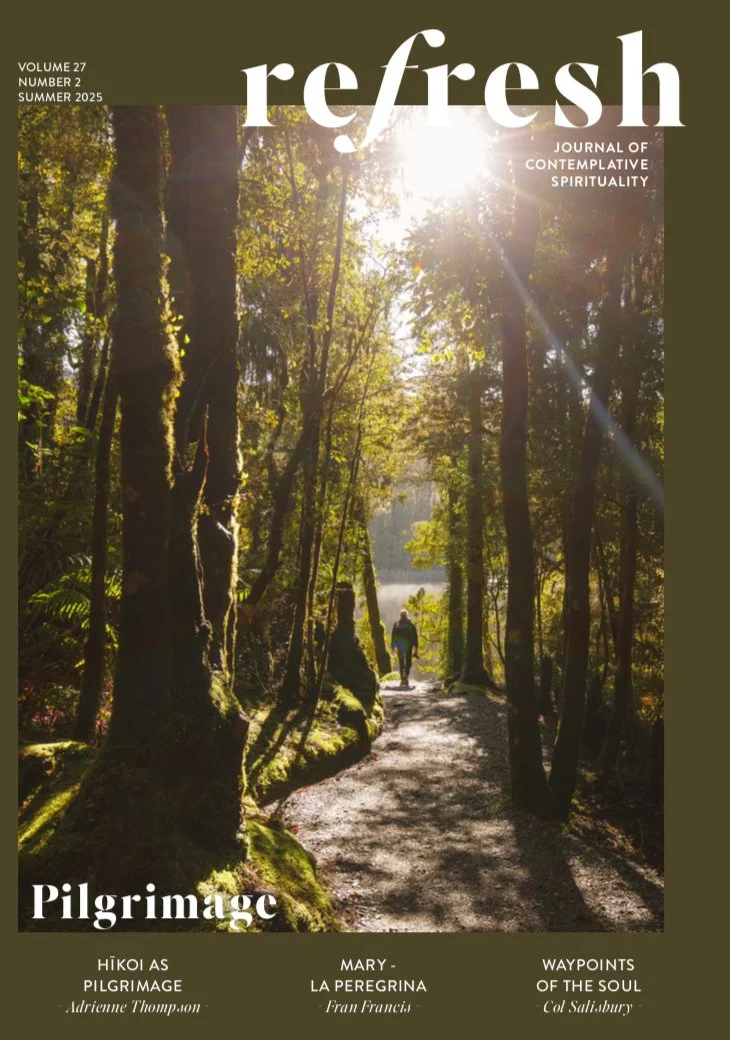
This article is published in the December 2025 issue of Refresh - Pilgrimage
The Way of Love
A Long Obedience in the Same Direction
Maria Popova, reflecting on walking, beautifully describes the steps of one’s life as ‘events, experiments, miniature rebellions against gravity and chance ... we choose to go one way and not another ... Every step remaps the psychogeography of the walker. Every step in space is also a step in time, slicing through the twilight between the half-fathomed past and the unfathomed future.’[1]
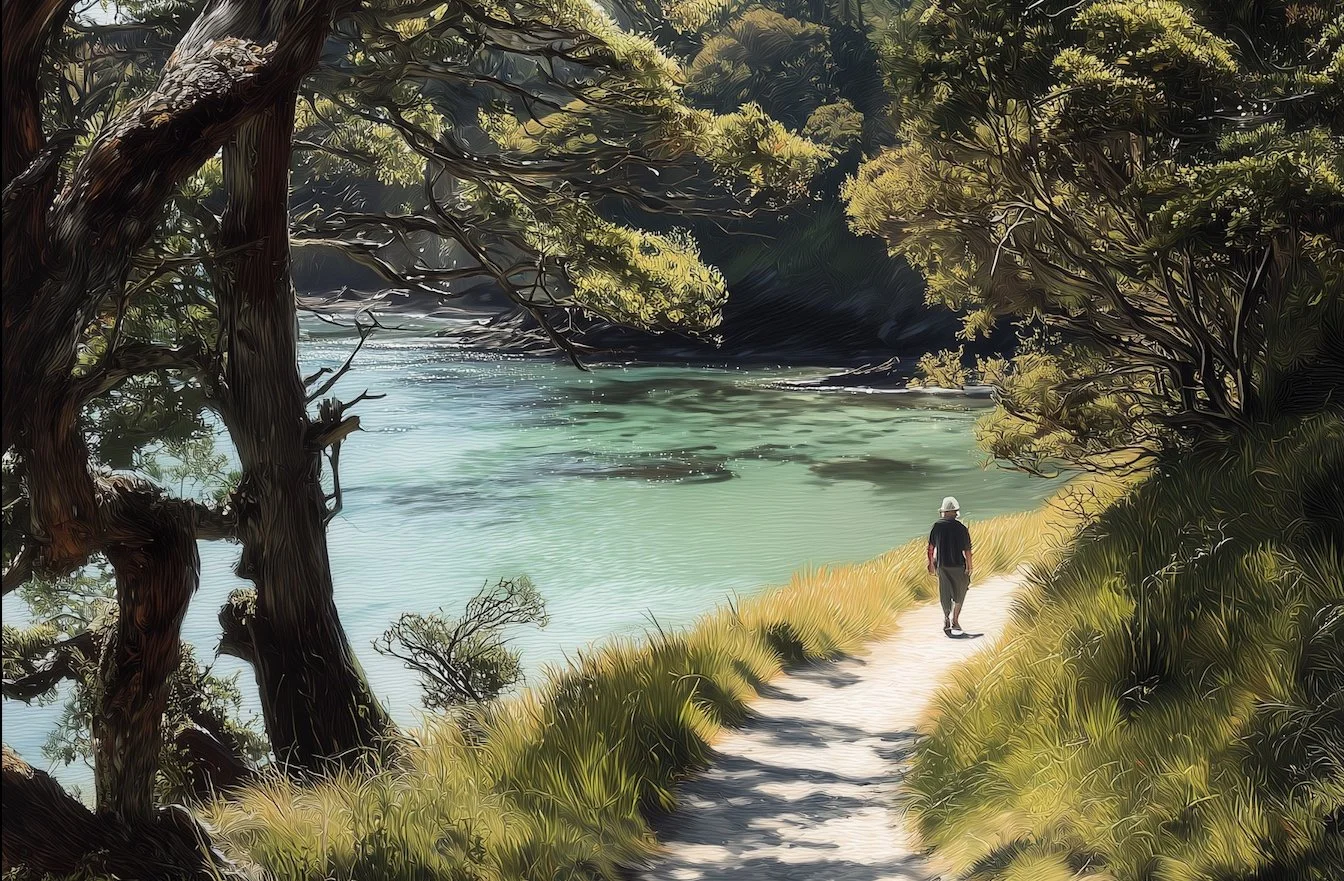
I recognise a psycho-geographical dimension to my coastal walking - quietly transformative experiences that remap and remake my sense of self and Other, and that run parallel with the deeper pilgrimage of my life, one that John Main describes as being ‘away from the self, away from egoism, away from selfishness, away from isolation, and into the infinite love of God’.[2]
Mine is pilgrimage in daily life, drawing me toward that Love which invites humble self-abandonment[3] which heals, and which slowly transforms the ways in which I’m uniquely invited to humanly image God revealed in Jesus Christ.
I believe we’re all summoned to follow a life-path – one that is external, and simultaneously an inner one that traverses the boundless inscapes of our souls.
David Whyte attaches the word pilgrim to an ‘unceasing tidal and seasonal becoming’.[4] This is my pilgrimage, less a break from daily routine, more a backwards and forwards becoming in daily life, one that takes seriously the incarnation, the call to follow the way of Jesus, and the possibility of divine-human encounter in everyday life.
The Ignatian metaphor for the spiritual life is pilgrimage.[5] Ignatius referred to himself as a pilgrim even when he was sitting at a desk in Rome. He dedicated his life to choosing what better led ‘to God’s deepening life’ within. His fellow Jesuit and friend Jerome Nadal said that the Ignatian way is a pilgrimage lived in imitation of Christ.
Eugene Peterson reminds us that the designation pilgrim refers to a people who spend their lives going someplace, going to God by way of the path that is Jesus Christ.
To live one’s life as pilgrimage is simply to be a wayfarer and wayfinder on the path of love.
It is to take seriously the linkages between one’s finiteness, people, places, and God; all in a way that is at once dynamic while also rooted in the everyday realities of our living.
Taking one’s spiritual life seriously is to feel the grace of one’s aliveness in motion, to feel the gift of one’s given days, to feel the tug, and to be on the pilgrimage of becoming as we follow in the way of Jesus; who is both ahead and walking alongside us, oftentimes unrecognized, as he was on the road to Emmaus.
I’ve found all this to be true in my own life; that in following Jesus I’m doing so in the midst of my everyday realities, working with my interior, my history, and my psychology. I’m learning by ‘living the questions,’[6] whilst not fully seeing the road ahead, nor being completely certain that I’m following God’s will, even when I think I am.[7]
Love has a compass, so I try to ensure that the direction of my life, and its everyday realities, are fostering sensitivity to God’s loving presence and invitations.[8]
God nudges, invites, and draws me onward into more of what it means for me to be truly alive. The way of love ‘means to be sensitive to life, to things, to persons, to feel for everything and everyone to the exclusion of nothing and no one.’[9]
The following reminders help me to responsively follow my path and to make space for divine-human encounter in the necessities of my everyday realities and responsibilities.
Firstly, every day I recognise, with Henri Nouwen, that my arms are too short; my eyes too dim; my heart and my understanding too small. To seek God means first of all to let yourself be found by God.[10]
Secondly, ‘the life of God is inseparable from ordinary human life,’[11] so I try to really live my ‘one wild and precious life’.[12] I don’t hide from it or talk myself out of it. God is found in all the experiences of my life, both struggles and joys.
Thirdly, life, like pilgrimage, demands a purity of intention. This helps me discern and weed out the false motivations, projections, prejudices, beliefs, and attachments of ego. All block sensitivity, discernment, and the ways I’m uniquely being invited to walk as a human being and Jesus-follower.
Finally, pilgrimage (in life)[13] helps me honour who I uniquely am, and the uniqueness of others too. In the light and the shadow that is my life, understanding it as a pilgrimage helps me learn when say ‘yes’, and when to say ‘no’.
The following prayer captures what feels so very central to my experience of life, a life that is the sum of God’s creative activity in it, while also being a pilgrimage into a fuller, freer, deeper, more Jesus-shaped experience of human be(com)ing.
God of All Times, Beyond All Time:
Let me not drift around in the sea of time.
Nor lose my way in the fog of confusion and choices.
Let me take the two hands of time, past and future, and stand in the embrace of time’s present body, awake, attuned, activated to choose wisely and engage each moment consciously, gratefully, with the praise of one who understands life’s journey as time-bound, and whose given days are unknown and also unrepeatable. Let me cherish each breath of time and become time’s student and wise wayfarer.[14]
[1] The Marginalian email, August 10th, 2025, writing about Craig Mod’s book Things Become Other Things: A Walking Memoir.
[2] John Main, 126.
[3] Jean-Pierre de Caussade.
[4] David Whyte, Consolations (Many Rivers Press, 2015), 161.
[5] Jim Manney, Ignatian Spirituality: A to Z (Loyola Press, 2019), 193.
[6] Rainer Maria Rilke.
[7] Thomas Merton.
[8] Helpful practices include the Ignatian examen and spiritual direction.
[9] Anthony de Mello.
[10] Henri Nouwen, with Stephen Rule, A Rule for a New Brother (Eerdmans 1973), 37.
[11] David Frenette.
[12] Mary Oliver in her poem ‘The Summer Day’.
[13] The Ignatian tradition offers the Spiritual Exercises as a ‘retreat in daily life’.
[14] Peter Traben Haas, Centering Prayers, Vol. 2 (2024), 144-145.
Paul Fromont and his wife live in Te Tai Tokerau on the beautiful Tūtūkākā Coast, the realisation of a long-held desire to live more simply, more contemplatively, and much closer to nature, especially the Pacific Ocean.
This article is in the Pilgrimage issue of Refresh - December 2025.
Refresh is SGM’s journal of contemplative spirituality in Aotearoa, New Zealand. You can view the current issue of Refresh or browse the archives in the Refresh section of this website.