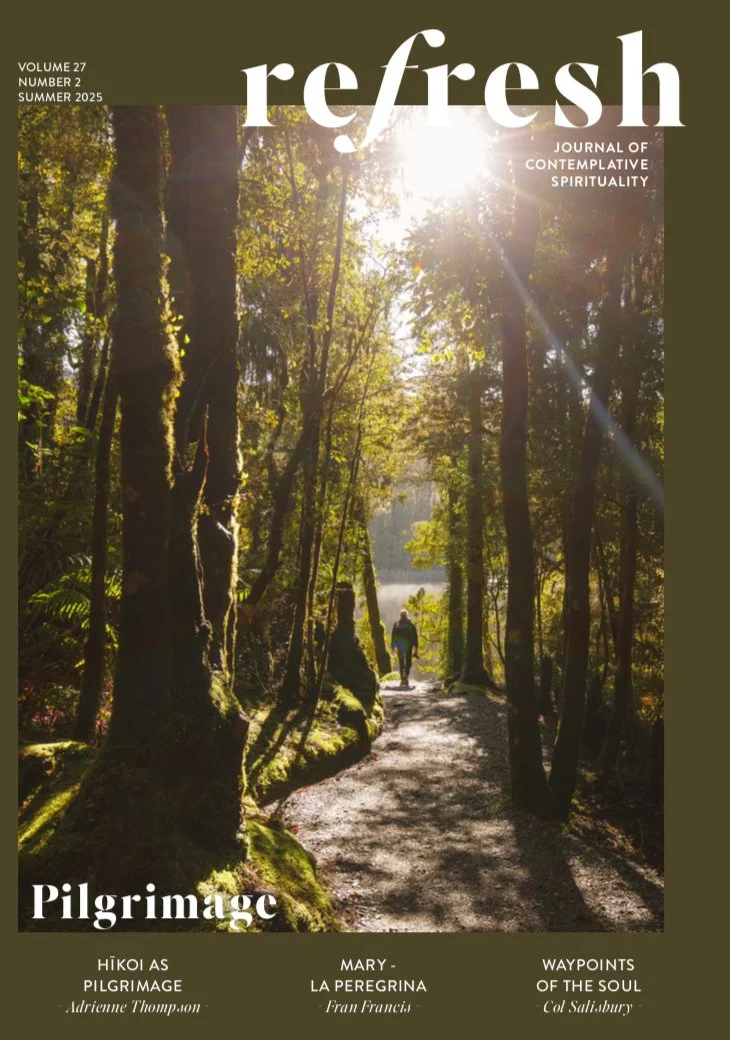
Mary, La Peregrina - By Fran Francis

Pontevedra_Santuario_de_la_Peregrina_altar785. Wikimedia CC 3.0.jpg
This article is published in the December 2025 issue of Refresh - Pilgrimage
In a scallop shaped chapel in the Spanish town of Ponte Vedra I climbed the winding stairs up into the dome. My back felt so sore – for the first time ever. I’d been travelling for weeks, walking kilometres every day on the most amazing pilgrim route imaginable. Yet suddenly, weirdly, I felt pain and it worried me.
Before I set out, it occurred to me to stop and say, with a bit of a laugh and both hands out, ‘Whaddaya have for me?’ to every saint I encountered. I had more opportunities to ask this than I could have imagined. And so often there was a moment of insight, a dream, a challenge, a gob-smacking wonder.
What I didn’t expect was to be asking this of Mary, the one who received the human body of God in her own flesh. I am not from a Christian tradition that venerates her. If anything, the opposite is true; complete avoidance of Mary except for a once-a-year mention on Christmas Eve. Personally though, through study and prayer, I have discovered friendship with the saints.
That day I wrote in my journal: 'had horrid back pain today. Prayed in the church of the Virgin Peregrina … and said, ‘If you are real, please help me with my back.’ … When I came down, my back wasn’t sore.’
Gazing at the painted bas-relief of Mary on her donkey, I sensed the chapel celebrated the feminine pilgrim - her unique vulnerabilities and how she holds life and the hope of salvation in her motherly arms. She carries hope on her hip.
Across the plaza, I bought a small gold medallion with La Peregrina on it, in her ridiculous hat and her staff with gourds dangling off it. The right-angled nature of holding hiking poles meant that wink of gold on a silk thread was in my field of vision all the way to Santiago de Compostela.
Of course, Mary was a pilgrim but we haven’t always noticed. Her first recorded journey was to her cousin Elizabeth in the hill country of Judaea. Imagine if she had stayed at home? No Magnificat, no affirming leap of John, no astonishing declaration of Elizabeth, ‘Who am I, that the mother of my Lord should visit me?’ The dangerous song of salvation proclaimed by these mothers of redemption, Mary and Elizabeth, would simply not have happened.
The canonical gospels don’t show us Mary on her way to Nazareth. It’s in the Protoevangelium of James (c.145 CE) that the donkey, the inn, the animals at the Adoration all come into view. Mary is on the road. It’s not fun. It is terrifying and sad. I know a woman who gave birth in the back of a truck after authorities forced her from her home in an ethnic cleansing. No-one wants to give birth in unfamiliar surroundings and without support.
Mary the pilgrim is more than a domesticated, tame example of prayer and devotion. She is travel-stained and sore and probably still makes dinner at the end of the day.
At the end of 2024, my pilgrimage year, 1 in 67 people were forcibly ‘displaced’ by conflict, climate change, persecution, violence, human rights violations or breakdown in public order.[1] 123.2 million people. Clearly my settled life in Beach Haven is very privileged.
Matthew’s Gospel describes Herod’s maniacal grip on power driving him to eliminate any possible threat no matter how young. Joseph bundles up the family in response to a prophetic dream and they flee to Egypt. Matariya, now in the suburbs of Cairo, is considered the most important site in the world for people wanting to connect with the refugee aspect of the Holy Family’s life.[2]
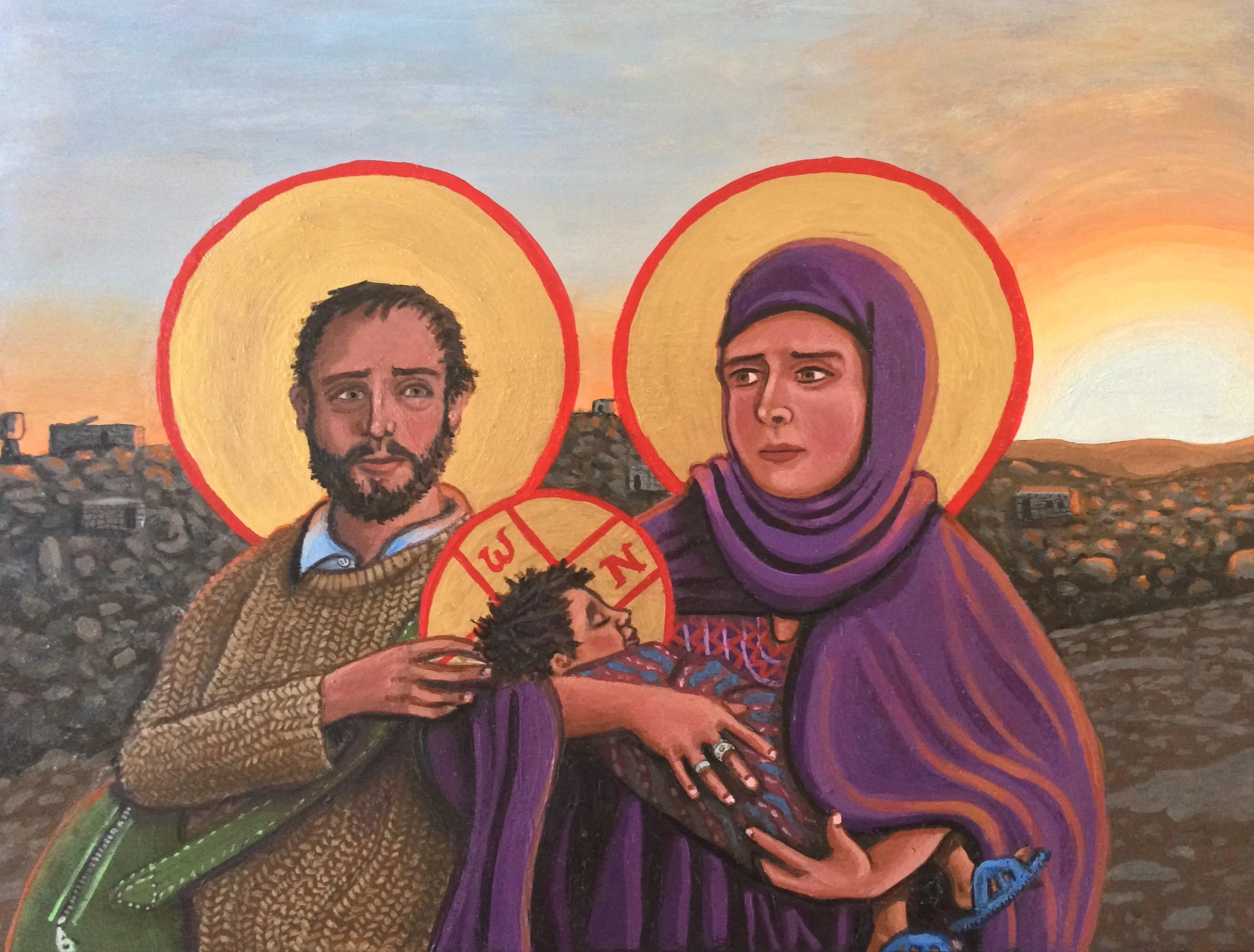
‘Refugees: The Holy Family’ - Icon by Kelly Latimore
Refugees then could easily be enslaved. A recent article by a Sudanese medical student-turned-refugee, Mohanad, exemplifies the reality now – the vulnerability, powerlessness, and terror of being on the run.[3] Running with a child, or having nowhere left to run with your child, is still the harrowing experience of too many people. Hunger for power and wealth are still the drivers of this injustice.
Our Mary made it to Matariya. Jesus’ early years were spent in a foreign land. Egyptian Coptic Christians have rejoiced ever since that their enslavement of the Hebrews was redeemed by saying yes to the refugee Christ.
The one intentional religious pilgrimage we see Mary make was to Jerusalem where Jesus was lost for three days. This Jewish pilgrimage with its communal nature of families and villagers travelling together is replicated on the various Caminos and pilgrimage routes of the world. People form ‘Camino families’ or intentionally go with groups of like-minded people.
It’s easier than you think to lose a kid on pilgrimage. We lost a 13-year-old briefly in Spain as he hared off and missed a Camino marker! Mary as parent, furious and frantic with worry, goes hand-in-hand with the less visible Mary who is caught up in the energy of the communal journey and experience.
By embracing Mary as religious pilgrim, we might find freedom to go on pilgrimage ourselves in the midst of parenting, taking family and friends with us. Yes, someone might get lost temporarily, but the road itself is populated with people to guide them back safely. Or we might just go alone. Many pilgrims answer their own call to the road, not depending on the company of familiar people.
The loneliest road for Mary must surely have been the one to Calvary. Those who have accompanied their children or loved ones in suffering and death, know this path - along with those whose loved ones have been taken by authorities, harmed by those in power, falsely accused, or trolled and publicly humiliated. Mary, now a 50-year-old woman, whose first yes to God has led her here, says yes to this path because that’s where love goes.
On a public highway in the middle of the afternoon, she is there with Jesus as he suffers and dies. Grief, loss, and suffering are roads no-one chooses but most of us are travelling them. Here Mary as pilgrim is walking in the grim spaces of institutional injustice, racial injustice, religious harm.
Have you ever wondered how Mary, as a devout Jewish woman, felt towards the Sanhedrin? Her faith leaders did this to her son, to her. Mary as witness, as mother, walked the road to Golgotha. How she made it home again that day, I cannot imagine. But she did.
We see her next in the Upper Room with 120 others, receiving the Holy Spirit and witnessing to the God she bore. It’s possible she moved to Ephesus with John. A small house is venerated as ‘Mary’s House’ there. Being part of the early ecclesia in Jerusalem and spreading the news of Messiah to the Jewish communities of Asia Minor, while not biblically supported, is evidenced in early writings from the Council of Ephesus (431 CE) and other documents.
This older Mary continues to grow, learn, and be open to new opportunities. She continues to say yes to life and to her God. This Mary, the contemplative and pilgrim, calls us to ponder the hard words (swords piercing hearts) and the hopeful ones.
We need companions on the journey. They are found not only among the living, but within the communion of saints who have gone before us. Theologian Elizabeth Johnson critiques the ‘intercessor’ model of Mary, and instead invites us to consider her as a companion, not between us and God but alongside.[4]
Robert Maloney explains Mary’s holiness as follows: ‘As life unfolded around her, often to her surprise, she had to figure out continually what God was asking of her. She looked for God in people and events, listened to that word, pondered on it and then acted on it.’[5] She lived a pilgrimage of faith. Like us. No fancy hats or gourds. Just one step at a time.
[1] https://www.unhcr.org/global-trends
[2] https://historicaljesusresearch.blogspot.com/2015/09/jesus-was-refugee.html
[3] https://www.theguardian.com/lifeandstyle/2025/aug/20/at-19-i-had-to-flee-my-country-afraid-for-my-life-without-even-saying-goodbye-to-my-family
[4] https://www.americamagazine.org/faith/2000/06/17/mary-nazareth-friend-god-and-prophet/
[5] https://www.americamagazine.org/from-our-archives/2005/10/19/historical-mary/
Fran Francis is National Co-ordinator (Kaiwhakahaere) of SGM’s Spiritual Directors Formation Programme. She loves collaborating with God to develop spiritual direction skills in others as well as creating retreats and spaces for people to adventure with God.
This article was featured in the Pilgrimage issue of Refresh - December 2025.
Refresh is SGM’s journal of contemplative spirituality in Aotearoa, New Zealand. You can view the current issue of Refresh or browse the archives in the Refresh section of this website.