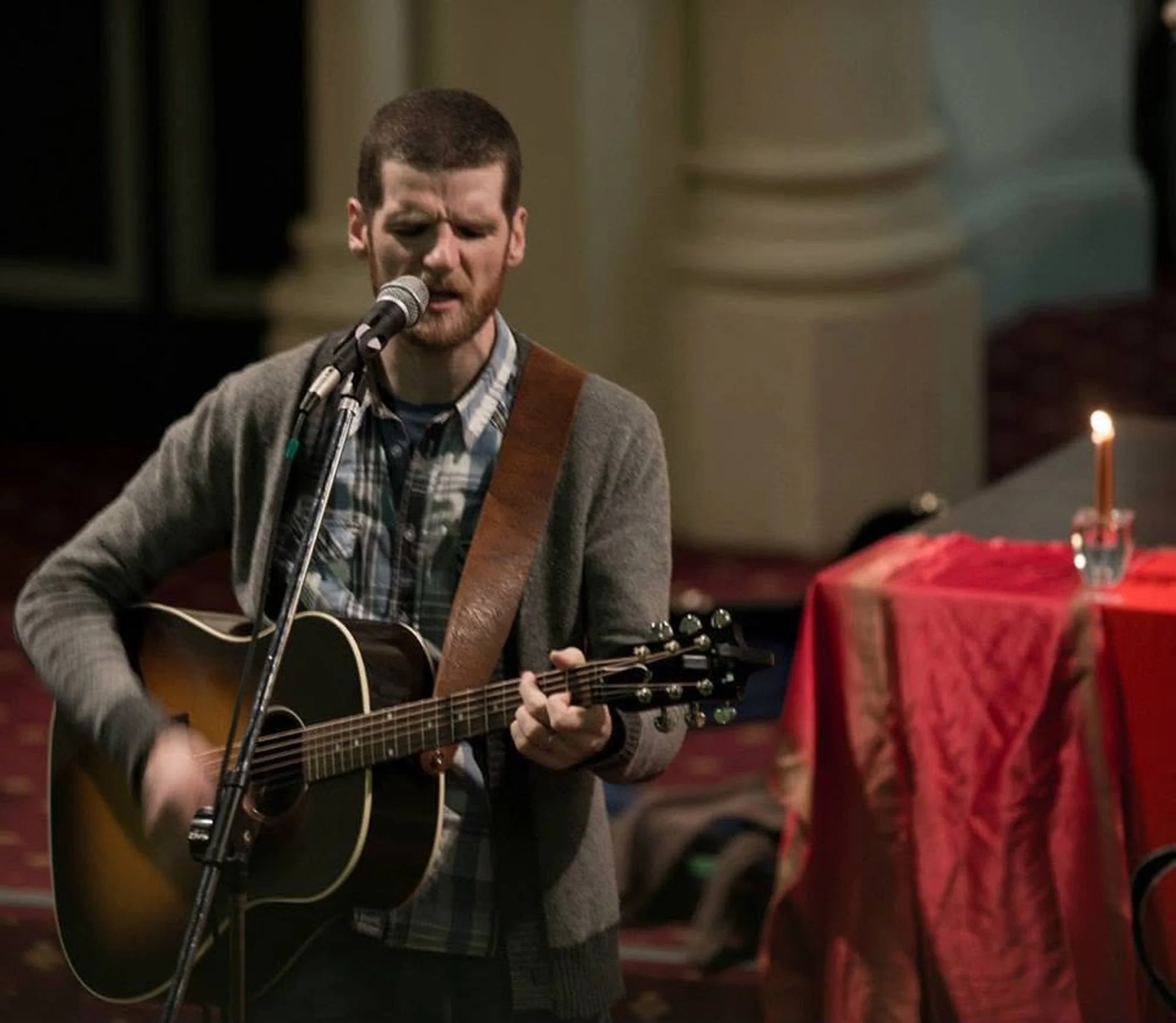
Singer/songwriter Malcolm Gordon in concert. Photo by Ian Thomson
This article is published in the ‘Creativity’ summer 2026 issue of Refresh Journal of Contemplative Spirituality
BY MALCOLM GORDON
That’s the funny thing about beginnings: you don’t always notice them when they’re happening.
Back in 2019, I sat down at the piano and wrote a song based on Matthew 11:28-30, ‘Come to me, all you who are weary, and I will give you rest.’ It came quickly, and the melody felt as if I’d discovered it rather than created it. I shared it with a friend who leads music at our family church — First Church of Otago — and she translated it into te reo Māori and we started using the bilingual version in services.
That was it. Or so I thought.
Fast forward to the end of 2023. I was constructing a big plywood nativity display for our upcoming Christmas services. As I worked, I had the Beatitudes rolling around in my head. Almost unconsciously, and in the key of the skill-saw I was using, I found myself singing, ‘Blessed are the poor in spirit.’
Around and around, I sang the words, trialling phrasings and discarding the ones that didn’t work, until it settled. The construction project flowed into the following week, when the reading was the Sheep and the Goats. Again, the Scripture found its way out of me and into song.
I wasn’t sure who was singing who; was I singing the Scripture, or was the Scripture singing me?
And that was it. Or so I thought.
A few months later, I found the passage from 1 John, ‘Beloved, let us love one another’ turning into a hum, and the hum turning into a tune. A week or so after that, Jesus’ greeting ‘Peace be with you’ turned itself into a song. I shared this song with the mother of a friend whose husband had just passed away, without any of the usual fretting over the quality of the recording or anxiety over its reception. I had received it as a gift, so I passed it on as such. By now, I’d noticed this handful of songs rolling around in my head. And for a few weeks I took to singing them like a little playlist stuck on repeat.
And that was it. Almost.
Except by now I had noticed. I had noticed that these songs were emerging, and that I wanted to sing them, regardless of the absence of an audience. In some ways, I felt like the audience myself, letting the words wash over me. I found myself wondering, these songs have just shown up without any effort on my part, but what happens if I try to write them? Would that ruin the magic?
So, around April 2024, I started leaving some space in my diary on Tuesday morning. I would sit with one of the lectionary texts, reading it, writing it out in full, and then, similar to a Lectio Divina process, I would take the words that caught my attention and see if I could find a way to sing them. I kept everything very lo-fi. I left my guitar in its case, trying to find the cadence that the words wanted to fall into, and then crafting a landscape for them to traverse — rhythm and melody emerging intuitively.
And then I sang. I would walk laps of the church hall as it bedded in. Then I would carry the song with me for the rest of the week: under my breath as I ran up the trails of Signal Hill near our house, or late at night while I walked the dog.
The insights that emerged would fuel the prayer meetings I led, the communions I held, and the sermons I preached. Even though no one else heard the songs.
Then I noticed something else happening. The singing meant I stayed with the passage much longer than when I simply read it and asked, ‘What does this mean?’ or ‘What can I preach about from this?’ It gave room for wonder and wondering. I found passages would open up in ways I had never experienced before.
Previously, I had been guilty of looking for new, interesting angles on Scripture to keep things fresh, both for myself and my congregation. Now, I found myself coming to the plainest readings of the text as if they were new and interesting. I was being confronted by the text in all its disarming simplicity. And I can only describe it like this: I felt the truth of the words, in my bones, rather than just knowing or believing.
It turned out I could write these songs if I tried. Not every song was amazing, but that didn’t stop it carrying the words deep into my soul. So, I didn’t agonise over writing an extraordinary melody every week, just something that could carry these words long enough for them to get lodged in me.
And as the practice continued, I noticed that these songs would circle back around. I would be driving to a meeting and find myself singing, ‘Love your enemies, do good and give, hope for nothing in return.’ Or I would be worried and I would start to hum, ‘Let not your heart be troubled. Believe in God and believe in me…’
The process began with me working on the songs, but it ended with them working on me.
I began to think of the Scripture as being like the sun, and the longer I could sing these prayer-songs, the more vitamin D my soul was getting. I even started diagnosing myself spiritually and prescribing the appropriate medicine. For example, when I came back from a difficult church meeting, I spent a lot of time singing, ‘Father, forgive them, for they know not what they do. Father, forgive me, for I know not what I do.’
Mid last year, I began wondering if these songs might have something to offer others. It was a question of genuine curiosity. When I was younger, there was a lot of ego tied up in my songwriting. And a lot of insecurity. I had needed people to like the songs, as evidence that they liked me. But these songs had been a holy secret. And they owed me nothing, for they had already formed me in wonder, patience, forbearance, delight, and so many other graces. So, I asked the question honestly.
I began at a ministry retreat, sharing a handful of the songs with some colleagues and their families. The warmth of the response was delightful. Because I needed nothing from the songs or from those I was sharing them with, their enthusiasm was pure joy to me. I heard the songs afresh, as if we were writing them together.
So, I opened this practice of praying the Scriptures in song to others. God’s creativity always makes community, and so it was in this case.
Starting in September last year, I led a singing circle in a local medical centre that serves those who can’t afford healthcare. I spend a lunch hour each week with whoever is in the waiting room: staff, volunteers and patients. Everyone who wants one has a songbook, and they choose the songs we will sing, and then (inevitably) we talk about how the Scriptures connect with their lives.
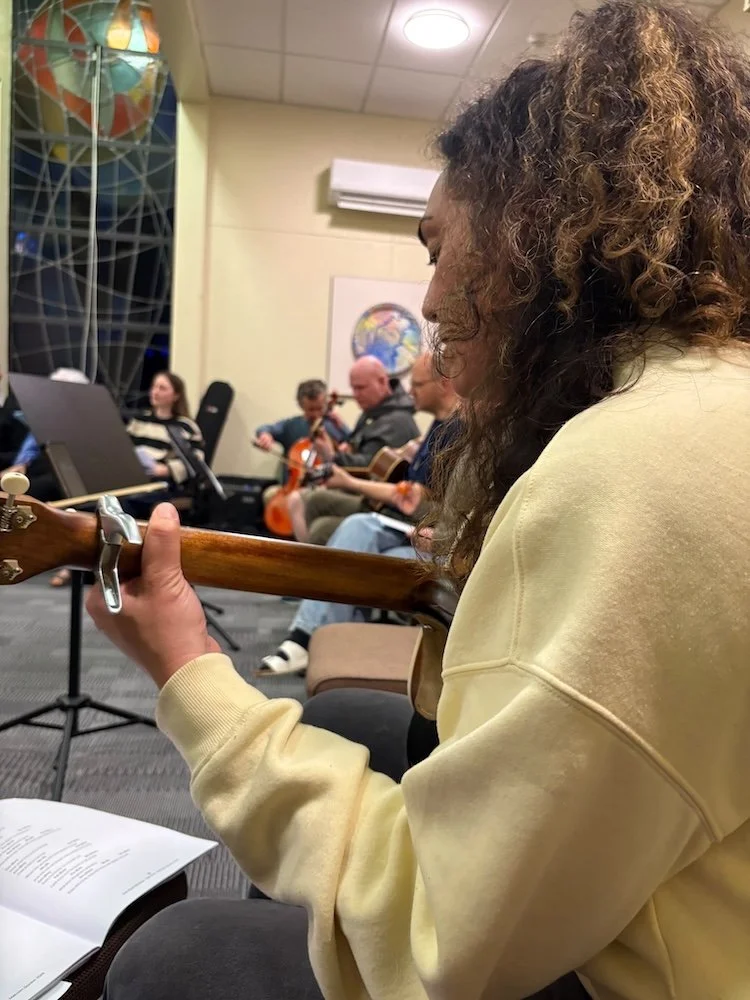
Photo by Rachel Spade
Then, once a month, I host a Night Chapel with folk from various churches, and some from no church at all, and we pray the Scriptures in song together. A good few bring their instruments and so the songs get written afresh all over again. Others come to sing or listen, while they colour or journal. We have begun to talk about the idea of being ‘SongKeepers’ — people who keep the story of God alive for the world we live in. So, we make space for people to tell stories of how the songs have helped them to be present in God’s name to a hurting world.
And in the last few months, the churches that these folk come from have been asking us to come and share this way of praying the Scriptures in song with them. We have started travelling around the city and the region, breaking open this practice to share with others. God’s creativity creates community.
And that’s it. As far as we know.
Receive this gift of 52 songs for singing into the story of Scripture.
You can download ‘The Word Became’ songbook and chord charts via our website. QR codes are provided for the recording of each song.
www.firstchurchotago.org/the-word-became
MALCOLM GORDON is an associate minister at First Church, a Presbyterian parish in the centre of Dunedin, exploring new ways of engaging with the Christian faith. He is a songwriter and has a PhD in lament. Download the booklet and listen to songs from The Word Became at www.firstchurchotago.org/the-word-became.