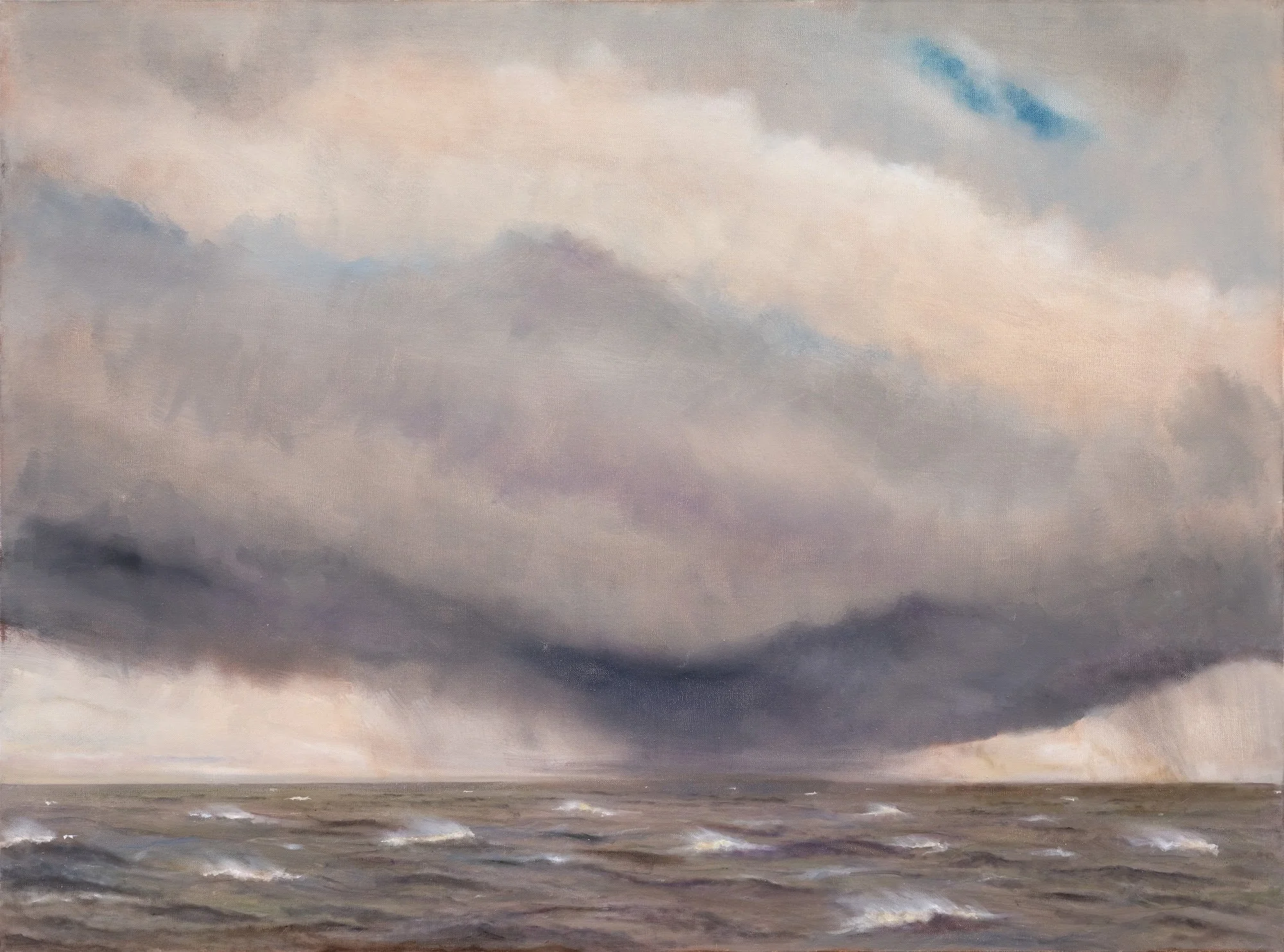
Afternoon Cloudburst Muriwai by Steve Tollestrup. Photo, artist's own
What do landscape painting and spiritual direction have in common? For artist and spiritual director Steve Tollestrup, both are contemplative practices that invite us to pay attention, relinquish control and make room for the unexpected. Drawing on his experience in the painting studio and the spiritual direction room, Steve reflects on creativity as a collaboration between skill, openness and the movement of the Spirit.
This article is published in the ‘Creativity’ summer 2026 issue of Refresh Journal of Contemplative Spirituality.
Whakarongo ki te whenua, ka kōrero te whenua
Listen to the land and the land will speak
Creativity has become a meeting place for the two worlds I inhabit: my work as a landscape artist and my practise as a spiritual director. Although they look different, both have taught me about paying attention, letting go of control and making room for what I cannot yet see.
As an artist working in oils, with a particular interest in landscape, I have learned to collaborate with my materials rather than make them behave. As a spiritual director, I have learned to listen rather than rush to interpret and to trust that something may emerge in the space between us that neither of us could have planned.
Creativity, for me, is what happens when intention, skill and openness meet — when I bring something of myself while remaining receptive to what I could not have produced alone.
This doesn't mean abandoning skill or discipline. Art requires intention and attention, just as spiritual direction requires training, experience and discernment. But neither practice works well when I try to control the outcome.
Creativity deepens when we become willing to listen. Swiss-German modernist painter Paul Klee put it beautifully: ‘I don’t see in order to paint. I paint in order to see.’
I have never completed a painting that looks exactly as I first imagined. Along the way, insights, intuitions, accidents and the medium itself begin to shape the work.
Almost every painting I think has some merit has, at some point, walked me into a corner where my skills seemed inadequate to move it forward.
And I’ve thought: Where to from here?
This apparent impasse is one of the places where creativity gets interesting. The temptation is to work harder, rework the painting, solve the problem and impose my will on it. But sometimes the more fruitful thing is to stop, relinquish mastery and listen.
I went to art school in my twenties, but returned to art more intentionally in my sixties. I had run out of words for what I wanted to say. Painting became another vocabulary and, more than that, an important contemplative practice.
The artist and spiritual director I carry within me are not so different. Both involve close attention, resisting premature conclusions and trusting what may emerge.
Both places I use for art and spiritual direction are called studios, places of attention, experimentation and self-discovery, where the sacred is also encountered.
Several years ago, I was fortunate to spend a week in residence with a Russian Orthodox icon painter in Auckland. That experience opened another dimension of creativity for me. In the Orthodox tradition, an icon is not simply decoration or illustration. The iconographer does not regard the work as an autonomous creation, but as participation in the creative mystery of God. This connects with the Orthodox understanding of theosis: participation in the life of God.
French artist Henri Matisse put it well: ‘I have been no more than a medium.’
The experience left me wondering whether landscape painting might offer another kind of iconography — of the natural world. Can a painting invite us to pause long enough to perceive something of the sacred presence within and beyond the landscape? Can I, in some small way, paint the land revealed as a thin place? That is a goal in much of my art. Painters such as Friedrich, Turner, Rothko and, here in Aotearoa, McCahon, seem to have understood something of this.
A few years ago I embarked on a series based on the mediaeval Book of Hours. I wanted to take a single landscape — west from Muriwai Beach towards the Tasman Sea horizon — and view it through the eight sacred offices of prayer: Matins, Lauds, Prime, Terce, Sext, None, Vespers and Compline.
I chose large canvases, 1200 mm by 900 mm, and faced a year of work, hoping to create paintings through which the viewer might sense the sublime — a contemplative moment.
It was a daunting challenge. At first I tried mastery. I took the skills I had acquired and attempted to render the scene using photographs I had taken. The basic image wasn't difficult: sea, horizon, sky. Within a few weeks I had covered the first canvas.
Standing back, what I saw was flat, boring and, honestly, hardly a step beyond wallpaper. Despair in the studio! I had walked myself into a corner. The Where to from here? moment had arrived.
For a couple of days I was a bit like Jacob wrestling with the angel. Eventually I gave up and simply sat looking at the painting. That's when something shifted. I stopped trying to make the painting conform to my intention and began to listen, to attend more intuitively to what was already there.
The painting began to suggest possibilities I hadn't anticipated. I became aware of light and colour, the movement of the elements and the quality of the atmosphere. These insights led me back with fresh energy. Experiments opened pathways; mistakes uncovered unexpected nuances.
Gradually, another painting emerged. When it was finished, my honest thought was not that I had succeeded, but that we had.
The materials had their say. My skills were present, and I had the conviction that what artists of the past termed the muse — the Holy Spirit — had been present in the new path forward. Let's call it a creative trialogue: materials, artist and Spirit.
That experience became a pattern for the remaining seven paintings. Each began with intention, but each demanded that I relinquish some control. Mastery could only take creativity so far.
The paintings echoed something I had been learning in another language, in spiritual direction. When I first began practising as a spiritual director, I was very aware of technique: skilful responses, appropriate questions, professionalism, the desire to do it well. There was a subtle wish to know where the conversation was going and how to be useful along the way.
A decade on, I am comfortable with not being the expert. I still bring experience, training and skills, but I have learned to lean into curiosity, abandon assumptions and be prepared to be surprised by both my directee and the Spirit. Each person brings a different soulscape. Each session is like a landscape painting that begins with a blank canvas.
Perhaps that is what creativity asks of us: not a choice between mastery and surrender, but a willingness to hold both. We bring what we have learned, then we listen.
Painting and spiritual direction both ask me to pay attention and relinquish the illusion that I am in control. Both invite me into a mystery in which something authentically alive and sacred emerges.
The painting studio and the spiritual direction studio have, for me, become one.
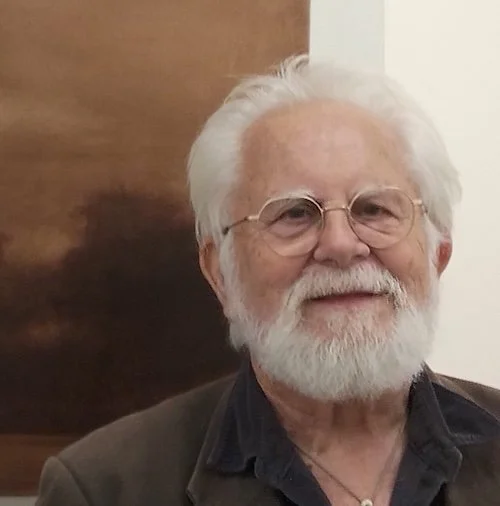
STEVE TOLLESTRUP is a spiritual director, supervisor and working artist living in West Auckland. He is also a guide at Auckland Art Gallery Toi o Tāmaki. Steve's art, including the Book of Hours series mentioned in this article, can be viewed online at stevetollestrup.crevado.com.